The Journal of Artificial Intelligence Applications and Data Science (JAIADS) is committed to ensuring the highest standards of scientific quality and integrity. To achieve this, all submitted manuscripts undergo a rigorous, formal peer review process.
Single-Blind Peer Review
JAIADS operates a single-blind peer review system. In this model:
- The reviewers know the identities and affiliations of the authors.
- The authors do not know the identities of the reviewers.
This approach allows reviewers to contextually evaluate the authors' previous work while maintaining the anonymity necessary for reviewers to provide honest, unvarnished, and constructive feedback.
The Review Workflow
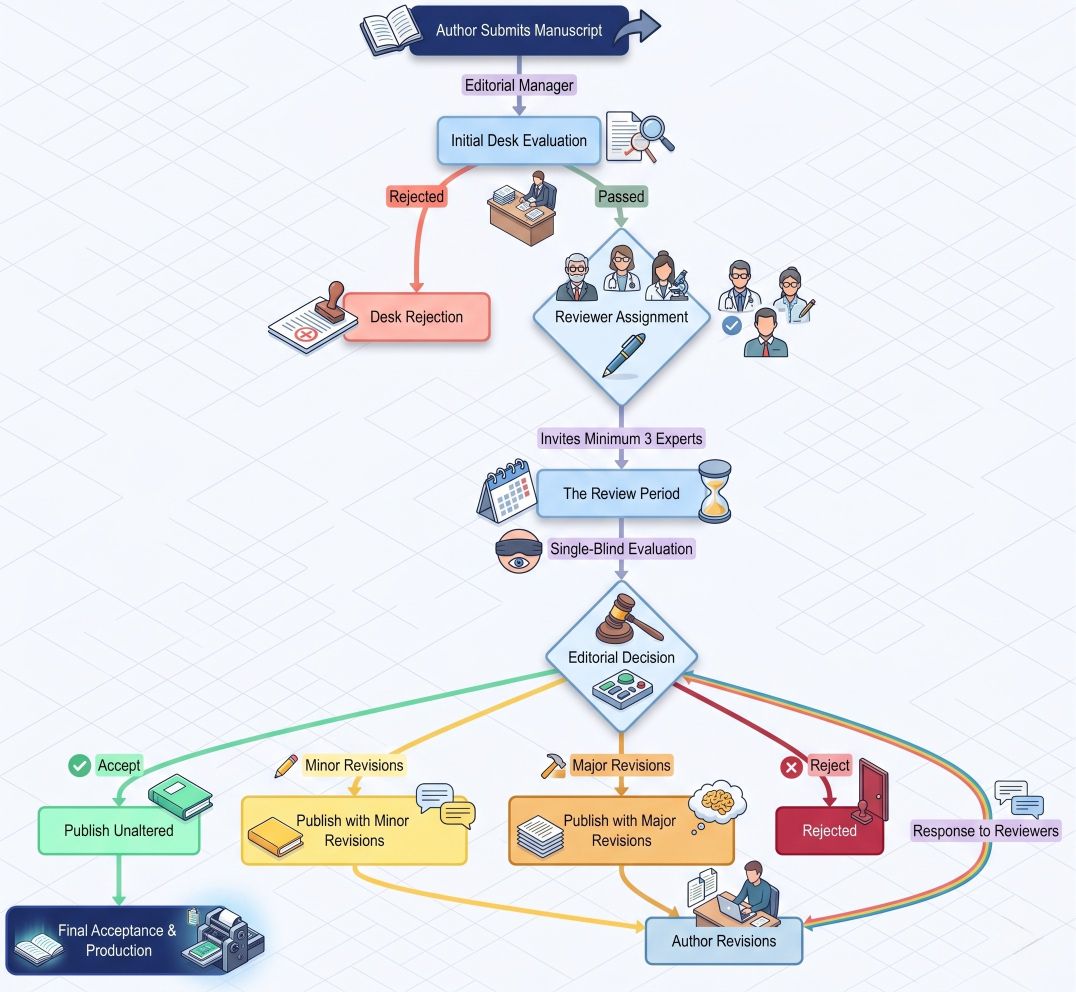
The entire peer review process is managed through our dedicated Editorial Manager platform.
1. Initial Desk Evaluation (Screening)
Upon submission via the Editorial Manager platform, the editorial team conducts an initial evaluation. This stage checks for:
- Alignment with the journal's aims and scope.
- Adherence to formatting, language, and structural guidelines.
- Originality, utilizing specialized anti-plagiarism software.
Manuscripts that fail this initial screening may be rejected immediately (desk rejection) without being sent for external review.
2. Reviewer Assignment
Manuscripts that pass the initial screening are forwarded to a minimum of three independent, expert reviewers. The Editor-in-Chief or a designated Handling Editor selects these reviewers based on their specific academic expertise, recent publications, and absence of conflicts of interest.
3. The Review Period
Reviewers are asked to evaluate the manuscript's scientific soundness, methodological rigor, originality, and clarity. They evaluate specific criteria (such as data robustness, literature relevance, and ethical compliance) and submit a standardized Review Report through the Editorial Manager.
4. Editorial Decision
Based on the comprehensive feedback and recommendations from the three reviewers, the Handling Editor makes one of the following decisions:
- Publish Unaltered: The manuscript is accepted in its current form.
- Publish with Minor Revisions: The authors must make small, non-critical changes.
- Publish with Major Revisions: The manuscript requires significant rewriting, additional experiments, or methodological clarifications. A second round of review may be required.
- Reject: The manuscript possesses fundamental flaws or lacks sufficient novelty and is not suitable for publication.
Author Revisions
When revisions are requested, authors must submit a revised manuscript along with a detailed "Response to Reviewers" document. This document must address every comment raised by the reviewers point-by-point, explaining precisely how and where the manuscript was modified.
Final Acceptance
The ultimate responsibility for accepting or rejecting a manuscript rests with the Editor-in-Chief. Once an article is formally accepted, it proceeds to the production phase for typesetting, proofreading, and eventual publication as an Open Access article.